The short answer
Sex toys do not come with one universal expiration date.
A well-made toy can remain perfectly usable for years, while another may need to be retired much sooner because the material, battery, motor, charging port or waterproof seal has deteriorated.
So do not throw a toy away simply because it is “old.”
Ask a better question:
“Has anything changed that makes this toy harder to clean, physically damaged, electrically unreliable or questionable to keep using?”
That is the decision that matters.
Cracks, tears and splits are a strong retirement sign
Inspect soft toys anywhere the material bends or joins another part.
Pay attention to seams, flexible necks, bases, textured areas, charging-port surrounds and places that repeatedly flex during use.
A true crack or tear is more than a cosmetic flaw. It creates an irregular damaged surface, can keep spreading, and may be much harder to clean as intended.
If the outer material has split, we would not try to glue or patch an intimate-use surface and call it repaired.
That toy has earned retirement.
Glass gets a harder rule
If a glass toy develops a chip, crack, sharp edge or rough spot, stop using it.
Do not “keep an eye on it.”
An intact glass toy can be extremely durable, but physical damage changes the safety picture immediately.
Run a careful visual and touch inspection before use if the toy was dropped or knocked against something hard.
Sticky or oily: troubleshoot first, then judge the material
A sticky surface does not always mean the toy is finished.
Residue, lubricant, cleaner, storage conditions and material compatibility can all be involved.
That is why our sticky or oily sex-toy guide starts with cleaning and product history instead of immediately declaring the material ruined.
But if a toy is cleaned exactly as directed and repeatedly becomes tacky, gummy, oily, soft or strangely textured again, the problem may no longer be something sitting on the surface.
The material itself may be changing.
Persistent surface breakdown is a much stronger reason to retire the toy than one sticky afternoon after using the wrong product.
A smell can be a clue too
A brand-new toy with packaging odor is one situation.
A familiar toy suddenly developing a persistent odor that survives proper cleaning and complete drying is another.
Our new-toy chemical smell guide explains why smell alone cannot identify a material.
For an older toy, smell becomes more meaningful when it arrives with other changes:
Stickiness.
Oiliness.
Softening.
Peeling.
Cracking.
Discoloration.
A surface that no longer feels like it used to.
Several changes together are more concerning than one clue by itself.
Does discoloration mean the toy is ruined?
Not automatically.
Some color transfer or fading can be cosmetic.
A toy can pick up pigment from another object or change appearance after long exposure to light without necessarily becoming structurally damaged.
What matters is what accompanies the color change.
Discoloration plus cracking, tackiness, peeling, unusual odor or softening deserves much more attention than color alone.
If your concern started after storing toys together, read our sex-toy storage compatibility guide before assuming two toys literally “melted” each other.
A weak motor does not automatically make a toy unsafe
Electronics wear too.
A motor that feels weaker than it used to can simply mean the toy is reaching the end of its useful performance life.
But troubleshoot first.
Fully charge it.
Confirm the correct charger.
Check travel lock or standby features.
Inspect charging contacts.
Make sure you are actually on the intended setting.
If performance continues deteriorating after those checks, replacement may eventually make more sense than fighting with it every time you reach for it.
A battery that dies quickly gets one more investigation
Poor battery life does not automatically mean “trash it.”
Our vibrator battery troubleshooting guide walks through charger alignment, contacts, intensity and battery aging before you decide the battery is finished.
But there is an important line:
Bad runtime is frustrating.
Physical battery damage is different.
If the toy becomes swollen, excessively hot, misshapen, smoky or develops a burning smell, stop using and charging it.
The U.S. EPA treats swelling as battery damage and a potential fire hazard.
Water damage can end an electronic toy
A toy advertised as water-resistant is not automatically designed for submersion.
If water gets into electronics, you may notice erratic controls, intermittent power, charging problems, corrosion, unusual sounds or condensation where it should not be.
Do not repeatedly charge a device you suspect has internal water damage just to see whether it recovers.
Check the exact manufacturer instructions first.
And if you are not sure what your toy was ever designed to tolerate, our waterproof vs water-resistant guide breaks down what to verify before submersion.
Damaged charging ports and seals matter
Look closely around ports, magnetic contacts and waterproof covers.
Stop and reassess if you see:
Exposed wiring.
Corrosion.
A charging port pulling away from the body.
Torn material around the port.
A broken waterproof cap.
Contacts that are loose or visibly damaged.
On a waterproof electronic toy, the enclosure is part of what keeps water away from the electronics.
A damaged seal is not merely an appearance issue.
There is no universal “replace every X months” rule
Calendar rules are tempting because they are easy.
They are also too simplistic.
A durable non-electronic toy made from a stable material can have a very different useful life from a soft porous toy or a rechargeable device containing motors, seals and a battery.
Condition matters.
Material matters.
Care matters.
Storage matters.
Manufacturer instructions matter.
Instead of throwing away a perfectly good toy because an internet checklist assigned it a birthday, inspect the actual object you own.
When should you stop troubleshooting?
There is a point where troubleshooting becomes wishful thinking.
Retirement is the better choice when the issue is persistent and structural rather than temporary and fixable.
Examples include:
A crack or tear that exposes damaged material.
Chipped or cracked glass.
Persistent tackiness or oiliness after correct cleaning.
A recurring unexplained odor combined with material changes.
Damaged wiring, ports or seals.
A battery that is swollen or dangerously hot.
Severe water damage.
Electronics that have become unreliable enough that the product no longer functions as intended.
You do not need every sign on the list. One serious sign can be enough.
Do not throw a rechargeable toy in the household trash
This is easy to overlook because the battery is often sealed inside the toy.
The EPA says lithium-ion batteries and devices containing them should not go in household garbage or curbside recycling. Damaged batteries can create fires during transport and waste processing.
Instead, look for an electronics or battery recycler, manufacturer take-back option, or household hazardous-waste program that accepts the type of device you have.
Local rules can vary, especially for damaged batteries, so follow the instructions of the recycler or waste program you plan to use.
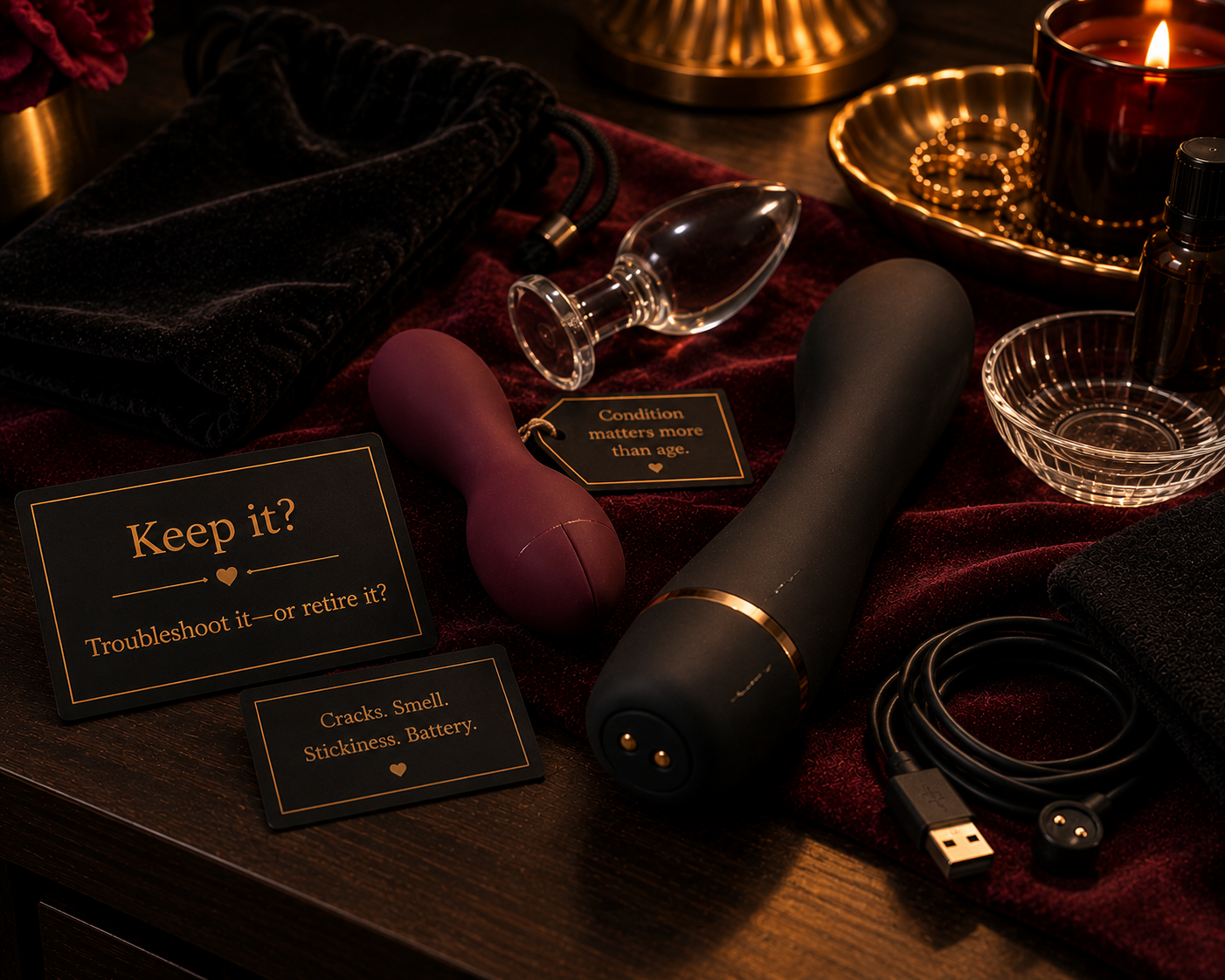
The RID keep, troubleshoot or retire test
Keep it
The surface is intact.
It cleans normally.
The electronics behave normally.
The charger and seals are undamaged.
Nothing meaningful has changed.
Troubleshoot it
The problem may reasonably be residue, charger alignment, storage, an incorrect setting, incomplete charging or another fixable issue.
Retire it
You have persistent material breakdown, physical damage, chipped glass, compromised electronics, serious battery damage or another problem that makes continued use unreasonable.
Reader questions, answered
How old is too old for a sex toy?
There is no single age limit. Inspect condition, material, electronics, charging behavior and manufacturer guidance rather than using the calendar alone.
Can I keep using a toy with one small crack?
We would not. A true crack is physical damage and can become harder to clean or continue spreading.
Is a sticky toy always ruined?
No. Rule out residue and compatibility problems first. Persistent tackiness that returns after correct cleaning is more concerning.
Can I put a rechargeable vibrator in the trash if the battery is sealed inside?
EPA guidance says devices containing lithium-ion batteries should not go in household garbage or curbside recycling. Use an appropriate battery/electronics or hazardous-waste collection option.
What if I simply do not trust the toy anymore?
You do not owe a damaged or questionable product continued use. If you cannot confidently clean, charge, store and use it as intended, retirement is a reasonable choice.
The RID bottom line
You do not need to replace a sex toy simply because you have owned it for a while.
But do not become sentimental about a toy that is visibly breaking down either.
Cracks, persistent material changes, damaged electronics, compromised seals and battery warning signs are all reasons to stop and reassess.
A good toy should be something you can confidently clean, charge, store and use—not something you have to keep convincing yourself is probably still okay.