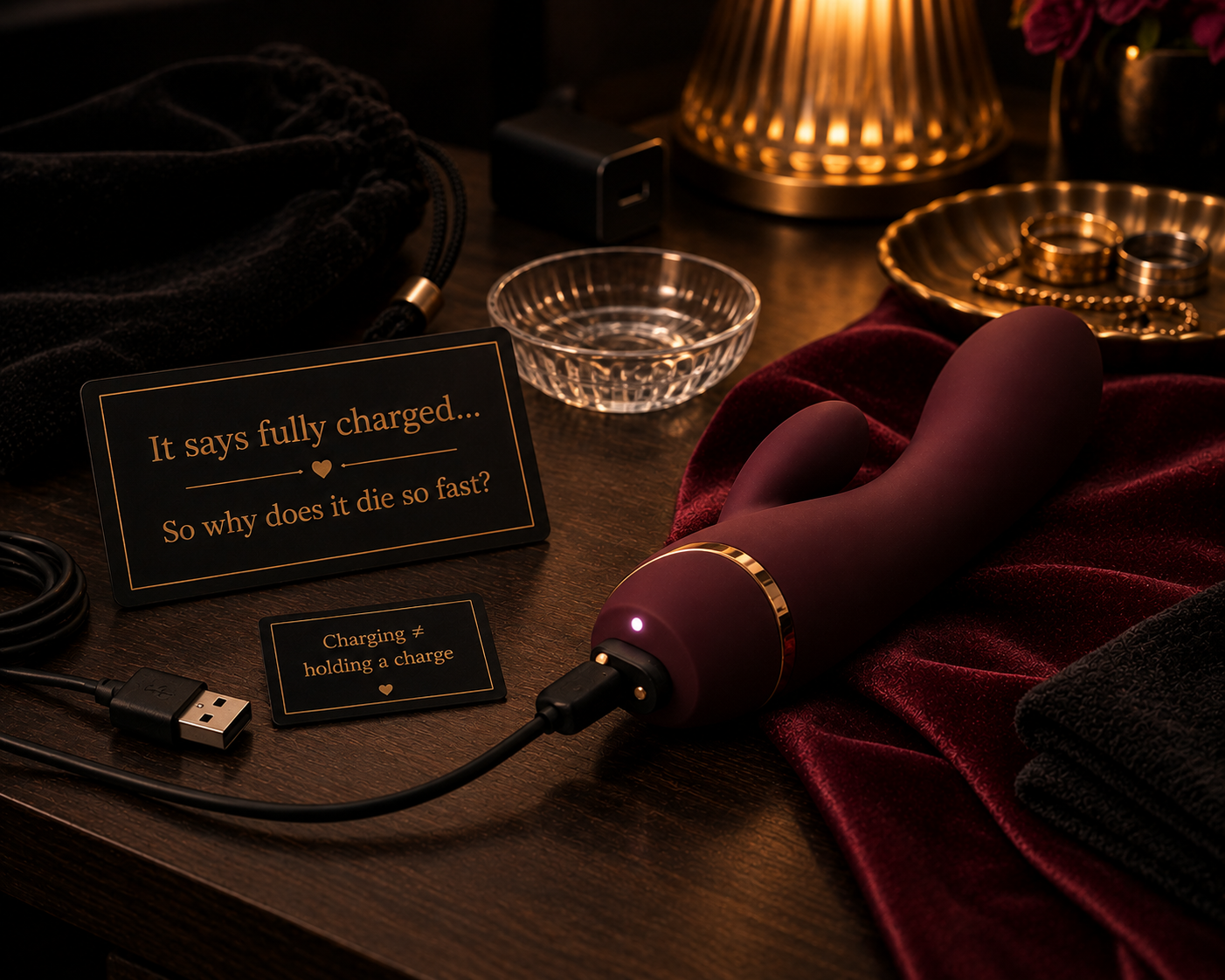
The short answer
Yes, a vibrator that charges but dies quickly may have a battery that is wearing out.
But “the charging light came on” does not prove the battery received a full charge, and it does not prove the battery is the problem.
Before you retire the toy, rule out the easier possibilities: incomplete charging, dirty contacts, a poorly aligned magnetic cable, the wrong replacement charger, high-intensity use, and a device that has been sitting discharged for a long time.
The useful question is not just:
“Does it charge?”
It is:
“After one proper full charge, does this specific toy still give me dramatically less runtime than it used to?”
Start with one controlled full charge
Use the charger or cable recommended for the exact model.
Make sure the toy and charging contacts are clean and completely dry. Attach the charger carefully and confirm that the charging indicator actually stays on.
Magnetic cables can be sneaky. They may look connected while one contact is barely touching.
For example, Womanizer’s current charging guidance tells owners to use the supplied cable, wait a couple of minutes, and confirm that the device is really charging before walking away.
That is a good habit with any rechargeable toy: do not assume the connection is good just because the magnet snapped into place.
Let the toy reach whatever its manual defines as fully charged, unplug it, and then test it normally.
If runtime suddenly improves, the problem may have been an incomplete charge rather than the battery itself.
Check the charger before blaming the battery
Look closely at the charging area.
Is there lint or dried residue on the contacts?
Is the connector sitting crooked?
Does the light flicker when the cable moves?
Does the toy charge only if you hold the cable at a particular angle?
Is the charging port loose or damaged?
Those are connection clues.
And if you lost the original cable, do not assume that another toy charger is safe simply because the pins appear to line up.
Our lost vibrator charger guide explains why physical fit is only one part of compatibility.
How long should the battery last?
There is no universal runtime for rechargeable sex toys.
A compact bullet, wand, rabbit, wearable, thrusting toy and air-pulse device can all have different batteries and completely different power demands.
The same toy may also run for a shorter period at maximum intensity than at a moderate setting.
Features such as multiple motors, heating, app connectivity, lights and stronger output can all use more power.
So do not compare your toy only with a different vibrator you happen to own.
Compare its current behavior with:
What the manufacturer says about that model.
How it behaved when it was newer.
How you are using it now.
That gives you a much better baseline.
A battery can say “full” and still have less capacity
Rechargeable batteries do not stay new forever.
As a battery ages, it can gradually hold less usable energy. The electronics may still report a completed charge, but the runtime after that charge can become shorter and shorter.
The pattern that gets our attention is:
Charges normally.
Shows full.
Runs much less time than it used to.
Keeps getting worse over repeated proper charges.
If that describes an older toy, battery wear becomes a much stronger possibility.
Has the toy been sitting unused?
Long storage periods can complicate the picture.
A rechargeable device that has been left completely discharged for months may behave poorly when you first bring it back out.
Do not automatically declare it dead after the first attempt.
Check the manual, give it a proper charge, and see whether performance improves after a normal charge/use cycle.
Some manufacturers also recommend periodically recharging devices that sit unused for long periods, so the exact storage guidance for your model matters.
Maximum intensity can make runtime look worse
Think about whether your habits changed.
Maybe you used to spend most of a session around level three and now you run the toy at maximum almost immediately.
That can make a healthy battery seem disappointing simply because the motor is drawing more power.
Try one ordinary session at a moderate setting. You do not need laboratory equipment or a spreadsheet. You are simply checking whether maximum power is the main reason the runtime changed.
If the toy still dies dramatically earlier than it used to, the battery question remains.
Signs the battery is probably wearing out
Battery wear becomes more likely when several of these happen together:
A full charge lasts only a fraction of the time it once did.
The toy shuts down unexpectedly even after a proper charge.
Power repeatedly fades or surges as the battery drains.
The battery loses most of its charge while sitting unused for a short period.
Charging seems to complete normally, but usable runtime keeps shrinking.
The device is old enough that battery aging is realistic.
At that point, check the warranty before replacing the toy.
Many sealed rechargeable toys are not designed for owner battery replacement. Opening the housing can damage waterproofing, seals or safety protections—and may void the warranty.
Heat, swelling or a burning smell is different
Poor runtime is an inconvenience.
A visibly damaged battery is a safety problem.
Stop charging and using the device if you notice excessive heat, swelling, bulging, smoke, hissing, a burning smell, or the body of the toy changing shape.
The U.S. EPA’s lithium-ion battery guidance specifically treats swelling as battery damage and a potential fire hazard.
Do not keep charging a swollen device to “see if it gets better.”
Contact the manufacturer and follow appropriate local battery or electronics disposal guidance.
What if the toy gets a little warm while charging?
Slight warmth is not automatically a failure.
Some manufacturers explicitly say that their rechargeable devices can become warm during charging.
What matters is whether the temperature is normal for that product or whether you are seeing unusual heat along with other warning signs.
If you are uncertain, unplug it and check the manual or manufacturer support page rather than guessing.
The RID battery check
Before you retire the toy, go in this order:
1. Confirm you have the correct charger.
2. Clean and dry the charging contacts.
3. Make sure the connector stays aligned.
4. Give it one proper full charge.
5. Test it at a normal—not maximum—setting.
6. Compare the runtime with the manufacturer’s information and the toy’s old behavior.
7. Check warranty coverage.
8. Stop immediately if there is swelling, excessive heat or another battery-damage sign.
That sequence separates a frustrating charging problem from a battery that is genuinely reaching the end of its useful life.
Reader questions, answered
Why does my vibrator say it is fully charged and then die?
The charging indicator may be working correctly while an aging battery holds less energy than it used to. But first rule out an incomplete charge or poor charger contact.
Could the wrong cable make it look like a bad battery?
Yes. A cable can appear to connect without charging correctly, and physically similar two-pin or magnetic chargers are not automatically compatible.
Does using the highest setting drain it faster?
Usually, stronger motor output requires more power. Multiple motors and extra features can reduce runtime too.
Should I open the toy and replace the battery myself?
Not unless the manufacturer specifically designed the battery to be user-serviceable. Opening a sealed toy can damage the enclosure, waterproofing and safety features.
Is a swollen rechargeable toy still usable if it turns on?
No. Battery swelling indicates damage. Stop using and charging it and seek manufacturer or local disposal guidance.
The RID bottom line
A vibrator that charges but dies quickly may be telling you the battery is aging—but do not skip the simple checks.
Correct charger. Clean contacts. Full charge. Normal intensity. Warranty.
If runtime keeps collapsing after all of that, the battery is probably the part that is finished—not your troubleshooting skills.