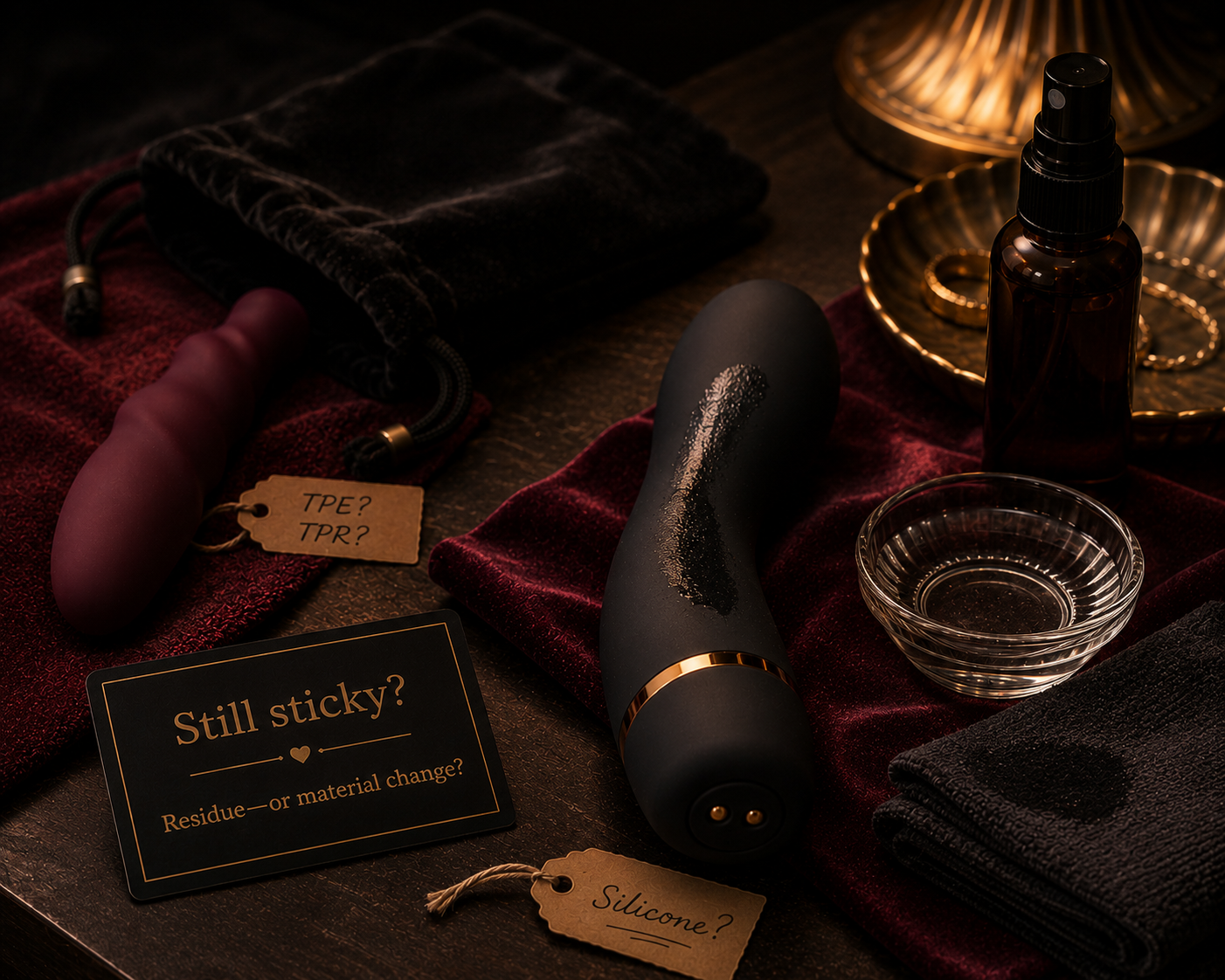
The short answer
A toy that feels sticky or oily after washing is telling you something changed—but that “something” is not always the same.
Possible causes include:
Leftover lubricant.
Soap or cleaner residue.
A naturally tackier surface finish.
TPE/TPR material behavior.
Oil migration from a soft material.
Contact with an incompatible product.
Actual surface degradation.
The fastest way to make a bad decision is to treat every sticky toy as the same problem.
First question: was it sticky when it was brand new?
That detail matters.
Some very soft elastomer materials can feel naturally tacky, especially after washing and drying.
A toy that has always had a slightly grippy surface is different from a toy that was originally dry and velvety but suddenly became oily six months later.
We care about change.
Ask:
Was this texture present from day one?
Did it start after a new lubricant?
Did it start after a new cleaner?
Did it happen after storing toys together?
Did it appear gradually with age?
Did the toy also change smell, color, softness, or shape?
Rule out ordinary residue first
Wash the toy exactly according to its care instructions and let it dry completely.
Do not judge the surface while it is wet.
Leftover water-based lubricant can feel tacky as it dries.
Some soaps can leave film.
Toy cleaner can leave residue if it is not used as directed.
Body oils can remain in textured areas.
If the surface returns to normal after correct cleaning and full drying, you may have had residue—not material breakdown.
What if it feels oily rather than sticky?
An unexplained oily film deserves more attention.
Some thermoplastic elastomer materials rely on oils or plasticizing ingredients to create softness.
Over time—or after contact with certain oils/materials—those ingredients can migrate toward the surface.
That can look or feel like:
An oily sheen.
Greasy residue.
A surface that stays slick even after cleaning.
Oil transferring to a storage pouch.
Another toy becoming tacky where the two touched.
If you do not know what the toy is made from, this is exactly why material identification matters.
TPE and TPR are not the same thing as silicone
TPE and TPR are broad families of thermoplastic elastomers.
Formulations vary.
Many are softer and more porous than quality silicone and can behave differently as they age.
That does not mean every TPE/TPR toy becomes a puddle.
It means you should not apply silicone-care assumptions to an unknown elastomer.
If the product page says TPE, TPR, “elastomer,” “real feel,” or another soft material, use the manufacturer’s care and replacement guidance for that material.
What should verified silicone feel like?
Quality silicone often has a dry, smooth, matte, or velvety surface depending on the finish.
It should not normally begin exuding an unexplained oily film simply because you washed it with an approved cleanser.
If a verified silicone toy suddenly becomes swollen, soft, tacky, or oily after exposure to a lubricant or another product, investigate compatibility.
Our Can You Use Silicone Lube With a Silicone Toy? guide explains why some silicone fluids can alter some silicone elastomers.
Could storage cause the problem?
Yes.
If the toy was stored pressed against another unknown soft material, separate them.
Then clean both according to their individual care instructions and inspect them after drying.
Our Can Sex Toys Touch in Storage? guide explains why “silicone toys melt each other” is too simplistic, while separate pouches are still a smart default when materials are uncertain.
What about toy powder or cornstarch?
Some soft elastomer products are sold with maintenance powder or instructions for lightly powdering the surface after cleaning.
That can reduce a naturally tacky feel.
But do not start powdering an unknown toy because somebody on a forum said all TPE needs powder.
Use the manufacturer’s instructions.
And do not use powder to disguise a surface that is actively oily, peeling, cracked, swollen, or degrading.
What if the toy leaves oil on its storage pouch?
Take the toy out and inspect both surfaces.
A pouch absorbing an unexplained oily residue is stronger evidence than “the toy feels a little grippy.”
Clean the product according to its instructions.
If oil returns after the toy is fully dry, contact the manufacturer or consider retiring the product—especially if the material is uncertain.
Does stickiness mean bacteria?
Not automatically.
A sticky surface is not a direct bacteria test.
But porous, damaged, cracked, peeling, or deteriorating materials can become harder to clean reliably.
So the important issue is not “sticky equals germs.”
It is whether the material is still intact, identifiable, and maintainable according to the manufacturer’s instructions.
What if only one small area is sticky?
Think about what touched that spot.
Possibilities include:
Silicone-based lubricant.
Massage oil.
Another toy.
Storage foam.
Adhesive.
A cleaning product.
A leaking battery compartment or internal material.
Local changes can tell you more than an entire toy that has always felt uniformly tacky.
When should I stop using it?
Stop and reassess when you see:
Cracks.
Tears.
Peeling.
Permanent swelling.
New oily leakage.
Material transferring to your hands.
Strong new odor.
Black or discolored spots that do not clean away.
Exposed internal parts.
A surface change that keeps returning after correct cleaning.
At that point the question is no longer “How do I make this feel less sticky?”
It is “Is this product still in good condition?”
Do not try to fix a deteriorating toy with stronger cleaner
More aggressive cleaning is not automatically better.
Alcohol, bleach, solvents, harsh disinfectants, and high heat can damage some toys.
If ordinary approved cleaning does not restore the original surface, check the manufacturer instructions rather than escalating to stronger chemicals.
Our Do You Really Need Sex-Toy Cleaner? guide covers routine cleaning separately.
The RID sticky/oily diagnostic
Step 1: Identify the material Silicone? TPE? TPR? PVC? Unknown?
Step 2: Clean exactly as directed Then let it dry fully.
Step 3: Compare with the original surface Was it always like this or is this new?
Step 4: Think about recent contact New lube? Cleaner? Oil? Another toy? Storage pouch?
Step 5: Inspect for other changes Odor, color, swelling, tears, residue, peeling.
Step 6: Ask the manufacturer Especially if the material or behavior is unclear.
Step 7: Retire it when uncertainty becomes the product’s main feature A toy is replaceable.
Reader questions, answered
Is TPE supposed to feel sticky?
Some TPE/TPR formulations can have a naturally tackier surface than silicone, and some manufacturers give maintenance instructions for that reason. A new change in texture still deserves investigation.
Why is my silicone toy suddenly sticky?
Possible causes include residue, incompatible lubricant exposure, contact with another material, or a surface/material change. Clean and dry it correctly, then compare it with how it originally felt.
Why is oil coming out of my toy?
Some soft elastomer formulations contain oils or plasticizing ingredients that can migrate. If an unexplained oily film keeps returning after cleaning, contact the manufacturer and consider retiring the product.
Can I put powder on it?
Only if the manufacturer recommends powder for that specific material.
Can I keep using it if it is sticky but otherwise looks okay?
That depends on whether the stickiness is normal for the material or a new sign of change. If you cannot establish that, do not let “it still looks okay” be your only safety check.
The RID bottom line
Sticky is a symptom, not a diagnosis.
Clean it.
Dry it.
Identify the material.
Think about what touched it.
Look for other changes.
If the original surface is not coming back and you cannot explain why, the toy does not get unlimited troubleshooting privileges.