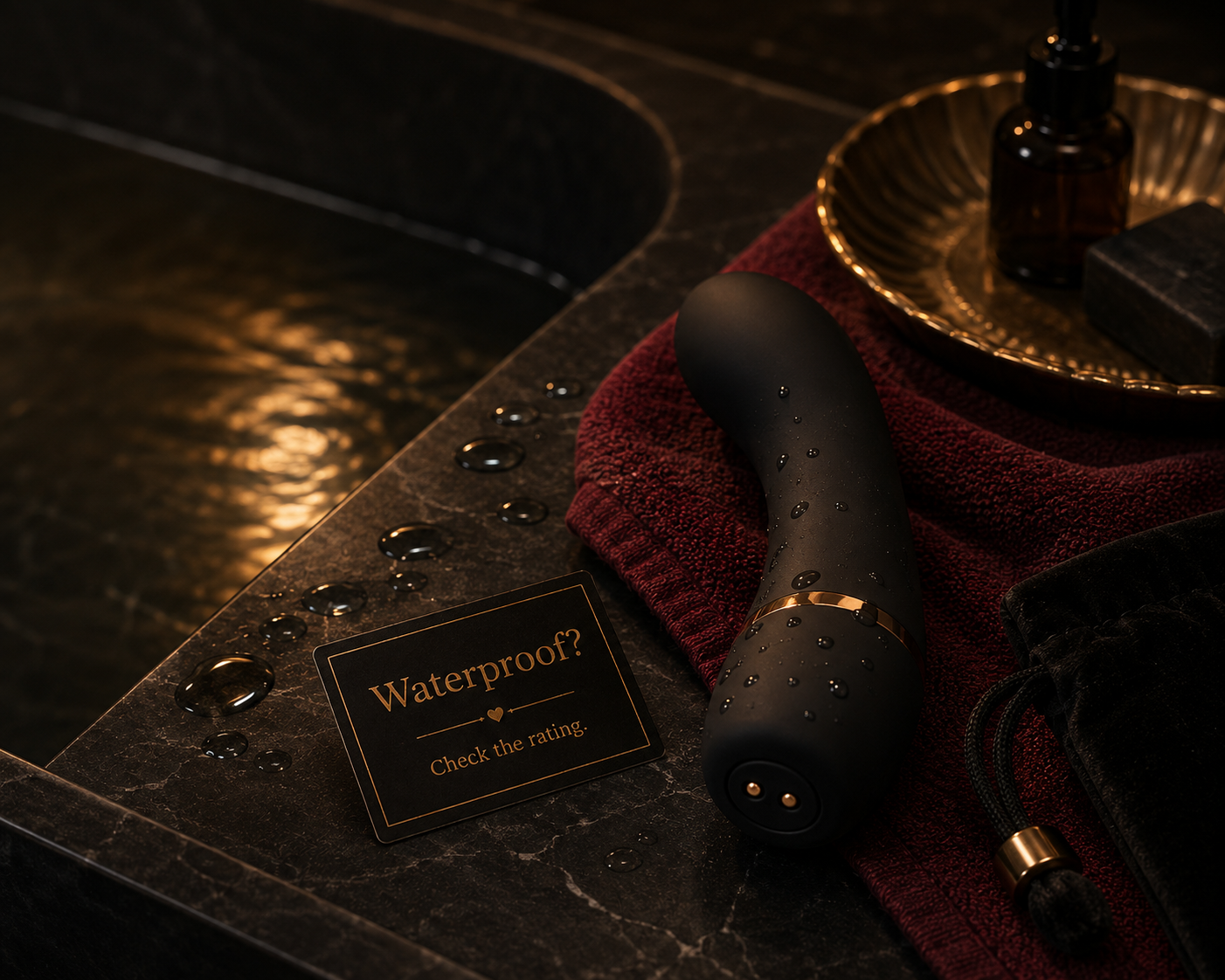
The short answer
“Waterproof” is useful only when you know what the manufacturer means by it.
A product page that publishes a real ingress-protection rating such as IPX7 gives you much more information than a listing that simply says “waterproof” in the title.
And even with an IP rating, follow the brand’s stated use conditions. Bath-safe does not automatically mean hot-tub-safe, saltwater-safe, unlimited-depth-safe, or safe to charge while wet.
Waterproof, water-resistant and splash-resistant are not interchangeable
Listings use these words loosely.
A toy described only as splash-resistant may be intended to survive surface moisture and careful cleaning—not immersion.
A brand that publishes IPX7 and explicitly says bath/shower use is giving you a much clearer promise.
The practical rule:
If immersion matters, look for the rating and the manufacturer’s written use statement.
What does IPX7 tell me?
IP ratings describe resistance to dust and/or water under standardized test conditions.
The “X” means the product is not making a dust-ingress rating in that position.
The “7” refers to temporary immersion resistance under defined test conditions.
That does not mean “indestructible underwater forever.”
It means you finally have a real test category to compare instead of a marketing adjective.
Real product example: Womanizer PRO
A useful marketplace listing should give you something concrete to verify—not just the word “waterproof.”
The current Womanizer PRO Amazon listing describes the toy as waterproof and suitable for bath/shower use. If you are shopping specifically for water use, compare that marketplace claim against the exact model’s current manufacturer instructions before submerging it.
See the current Womanizer PRO listing on Amazon.
The point is not that RID is naming a “best waterproof toy.” The product is here as an example of the kind of claim a shopper should verify before buying.
What good waterproof disclosure looks like
Current products from established brands such as Womanizer, We-Vibe and LELO often publish an IP rating and/or explicit bath-and-shower language on their own product pages.
That is the standard RID wants you to look for:
Rating or specific water-resistance claim.
Plain-English intended use.
Instructions for the exact model.
What if the listing says “100% waterproof” but gives no rating?
Look for:
The official manual.
The brand’s support page.
A separate specifications tab.
Cleaning instructions.
Whether the charging port is sealed or exposed.
Whether the manufacturer explicitly says bath/shower/submersion.
If all you have is a marketplace title using “waterproof,” you still have a question—not an answer.
Does a magnetic charging port mean it is waterproof?
No.
Magnetic contacts can appear on waterproof products, but the charging design itself does not establish the waterproof rating.
The enclosure, seals, buttons, seams, internal construction, and testing matter.
Use the published rating or manufacturer statement.
Can I charge a waterproof toy while it is wet?
Do not.
Waterproof use and charging are separate operating conditions.
Dry the toy and charging contacts fully before connecting power unless the manufacturer explicitly says otherwise.
The same rule applies after washing: “waterproof” does not mean “connect electricity while water is sitting on the contacts.”
Is shower-safe the same as bath-safe?
Not automatically.
Shower use mainly exposes a product to running/splashing water.
Bath use involves immersion.
A brand that explicitly permits both removes the guesswork. If the manual mentions shower use but says nothing about immersion, do not upgrade the claim yourself.
What about a hot tub or pool?
Do not assume bath approval automatically covers every body of water.
Heat, chemicals, salt, pressure, depth, and exposure time can differ.
If you specifically want pool/hot-tub use, look for manufacturer guidance for that environment.
What if water gets inside anyway?
Stop using and charging the toy until you know what happened.
Warning signs can include:
Fogging inside transparent parts.
Unexpected sounds.
Weak or erratic motor behavior.
Corrosion at contacts.
Charging failure.
A seam or cover that no longer closes correctly.
A claimed waterproof rating does not make visible seal damage irrelevant.
Cleaning is where waterproof ratings matter too
A fully submersible toy is often easier to rinse thoroughly.
A non-waterproof or splash-resistant motorized toy may require careful surface cleaning to keep water away from the electronics.
That is why our Do I Really Need Sex-Toy Cleaner? guide starts with the toy’s own care instructions rather than one universal washing method.
The RID waterproof-listing test
Before you take a rechargeable toy into the bath:
1. Find the exact model.
2. Find the official specification/manual.
3. Look for an IP rating or explicit immersion language.
4. Check whether bath/shower use is specifically permitted.
5. Inspect seams, caps and charging contacts for damage.
6. Never charge while wet.
7. Stay inside the manufacturer’s stated conditions.
Reader questions, answered
Does IPX7 mean I can use it in the bath?
IPX7 indicates temporary immersion resistance under standardized conditions, but the manufacturer’s own instructions still control the intended use. Brands like Womanizer and We-Vibe explicitly pair IPX7 with bath/shower approval on current products.
Is “water-resistant” enough for a shower?
Maybe, maybe not. The phrase alone is too vague. Look for a rating or an explicit shower-use statement from the manufacturer.
If it has a sealed silicone body, is it waterproof?
Not necessarily. Buttons, seams, charging contacts and internal construction also matter.
Can I rinse any vibrator under the faucet?
No. Check the care instructions first. Some products are submersible; others are only surface-cleanable.
Does waterproof mean dishwasher-safe?
No. Heat, detergent and dishwasher conditions are separate from a water-ingress rating.
The RID bottom line
Do not translate “waterproof” into whatever water activity you had in mind.
Make the listing prove the claim.
Rating. Manual. Intended use.
If those three agree, you have an answer.