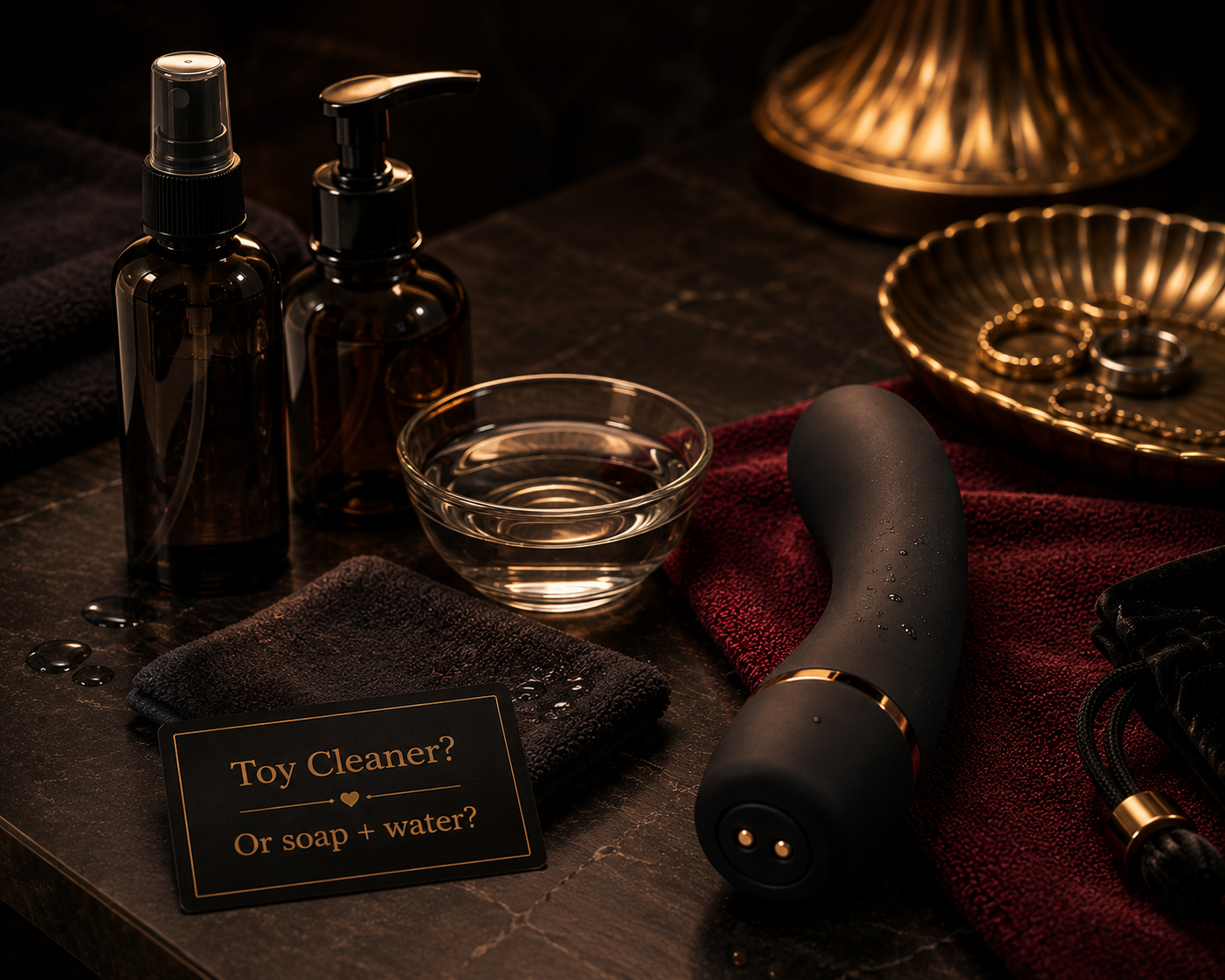
The short answer
For many washable sex toys, you do not need a special branded toy-cleaner spray.
Mild soap and warm water are standard general guidance for many materials—but the toy’s own care instructions still come first because electronics, waterproof ratings, porous materials, removable sleeves and specialty finishes are not all cleaned the same way.
Toy cleaner is an option, not a universal requirement.
Why do toy cleaners exist then?
Convenience.
A purpose-made cleaner can be useful when:
The manufacturer recommends it.
You want a quick surface-cleaning product.
The formula is compatible with the toy material.
You prefer not to use your household soap.
You are traveling and a spray is easier to pack.
That does not mean soap suddenly stopped working.
What does mainstream sexual-health guidance say?
Planned Parenthood’s sex-toy guidance recommends cleaning toys before and after use with mild soap and warm water, while also telling users to pay attention to the specific care instructions.
That second half matters just as much as the first.
“Soap and water” is a general starting point—not permission to submerge a motorized toy whose manual says wipe-clean only.
What does a manufacturer say?
Manufacturer guidance varies by product.
For example, a We-Vibe manual for an IPX7 product instructs users to clean a removable silicone sleeve with toy cleaner or antibacterial soap and then dry it.
That is a good illustration of why the manual wins: the manufacturer knows which parts can be immersed, detached or cleaned more aggressively.
When is a cleaner worth buying?
A cleaner makes the most sense when you have already confirmed it is compatible with the toy and you value convenience.
One current example is pjur TOY CLEAN, which the manufacturer describes as alcohol- and perfume-free and intended for erotic-toy cleaning.
If you prefer a purpose-made cleaner, see the current pjur TOY CLEAN listing on Amazon.
Again, the existence of the cleaner does not mean you need it for every toy.
What kind of soap should I use?
“Mild” and “unscented/fragrance-free” are the useful ideas.
Avoid assuming that stronger, more fragrant or more antibacterial automatically means cleaner.
Harsh household cleaners, solvents, bleach products, alcohol and disinfectants can damage certain materials or coatings unless the manufacturer specifically permits them.
If the product manual names an approved cleaner or soap type, use that guidance.
Do I need to disinfect every toy after every use?
Cleaning and high-level disinfection are different goals.
For ordinary solo use, routine cleaning according to the manufacturer is generally the relevant task.
If a toy is shared, switches between body areas, or needs a higher level of sanitation for a particular reason, material and construction matter much more.
Not every motorized product can be boiled, bleached or put in a dishwasher just because some non-motorized silicone products can tolerate those methods.
Can I boil a silicone vibrator?
Do not boil a motorized/rechargeable toy unless the manufacturer explicitly says it is safe.
“Made with silicone” does not mean the motor, battery, seals and charging components can survive boiling temperatures.
Material and complete-product construction are separate questions.
Can I put it in the dishwasher?
Same answer: only if the manufacturer says so.
Waterproof is not dishwasher-proof.
Dishwashers add heat, detergent, spray pressure and extended cycles that are not described by an IP water rating.
What if the toy is not waterproof?
Do not submerge it.
Follow the manual’s surface-cleaning instructions and keep water away from battery compartments, seams, ports and controls that are not designed for immersion.
Our Waterproof vs Water-Resistant Sex Toys guide explains why “waterproof” language needs to be verified before washing.
Do I need to clean a brand-new toy before first use?
Yes, follow the manufacturer’s cleaning instructions before first use.
A product can pick up dust, packaging residue or handling during manufacturing and shipping.
“New in box” is not the same thing as “already cleaned for your body.”
What if the toy stays sticky after washing?
First rule out obvious residue from lubricant, soap or storage.
Wash again according to the care instructions and let it dry completely.
If the surface remains tacky, oily, swollen, cracked, peeling or chemically different from when it was new, stop treating the problem as dirt.
The material may be changing.
That is a different troubleshooting question from routine cleaning.
Drying matters more than people think
Do not put a damp toy straight into a sealed bag or drawer.
Water can remain in:
Texture.
Seams.
Ports.
Removable sleeves.
Hollow areas.
Storage pouches.
Let the product dry fully according to its instructions before storage.
Then store it somewhere clean and appropriate for the material.
Our Can Sex Toys Touch in Storage? guide covers the material/contact question separately.
The RID cleaning decision tree
1. Is there a manual? Use it.
2. Is the whole product waterproof? If no, do not submerge it.
3. Does the manufacturer permit mild soap and water? Use that as the routine method.
4. Do you prefer a toy cleaner? Choose one whose compatibility is clearly stated.
5. Does the toy have a motor/battery? Do not improvise boiling/dishwasher/high-heat methods.
6. Is it fully dry? Only then store it.
Reader questions, answered
Is sex-toy cleaner a scam?
No. It is a real convenience product. It is simply not mandatory for every washable toy if mild soap/water is already an approved care method.
Can I use hand soap?
Only if it is mild and the toy manufacturer’s instructions permit that type of cleaning. Fragrance-heavy or harsh formulas may be a poor choice.
Is antibacterial soap better?
Not automatically. Compatibility with the toy and correct cleaning technique matter more than the word “antibacterial” on the bottle.
Can I use rubbing alcohol?
Only when the manufacturer says the material/surface can tolerate it. Alcohol can damage some finishes and soft materials.
Why does my toy smell after cleaning?
Persistent odor after correct cleaning can point to trapped moisture, residue, or material changes. If the odor is new and will not wash away, stop using the toy until you understand the cause.
The RID bottom line
Toy cleaner can be useful.
It is not a permission slip to stop reading the manual.
The best cleaning method is the one approved for the exact material, electronics and waterproof construction you actually own.