The short answer
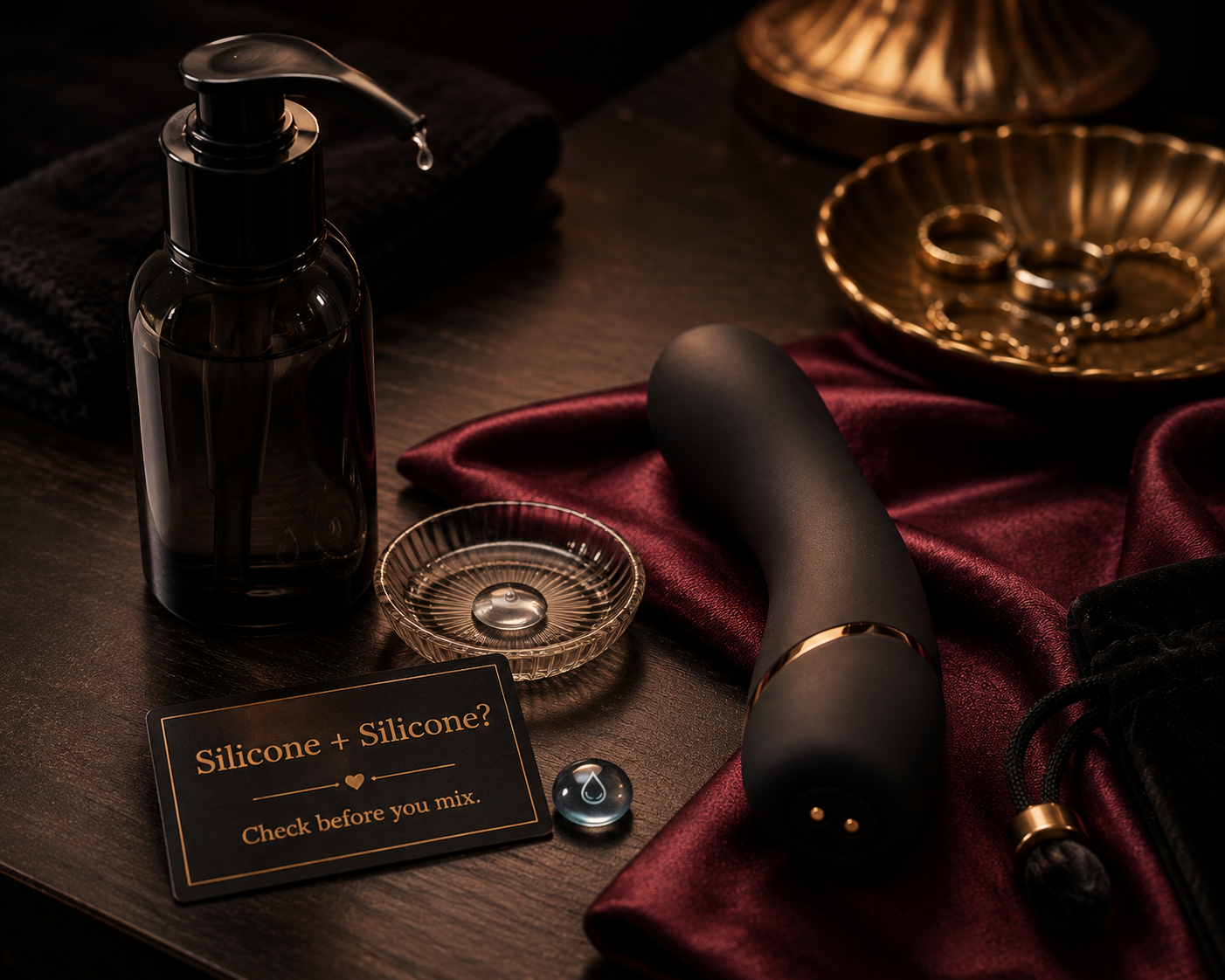
Water-based lubricant is the low-risk default for silicone toys.
Silicone-based lubricant can interact with some silicone toy formulations, and the internet turns that into two equally unhelpful absolutes: “silicone always destroys silicone” and “high-quality silicone is always fine.”
The useful answer is more careful:
Check the toy manufacturer’s instructions. If the brand does not explicitly approve silicone lube, use water-based lubricant instead.
Why is the advice so contradictory?
Because “silicone” describes a family of materials and formulations, not one single recipe.
The solid elastomer used in a toy and the fluid silicones used in lubricants can vary.
Compatibility can depend on formulation and exposure.
That is why a general internet rule can never know more about your exact product than the company that manufactured it.
The conservative health-education guidance
Planned Parenthood’s published sex-toy guidance says silicone-based lubricant can damage some silicone sex toys and that water-based lubricant is generally safe for most toys.
That is a sensible default when you do not have model-specific compatibility information.
Why can silicone lube change a silicone surface?
Silicone fluids can sometimes be absorbed into silicone rubber and cause swelling or softening.
What that looks like in real life can include:
A tacky patch.
Swelling.
A softened surface.
Texture change.
Material becoming easier to damage.
The exact outcome depends on the formulations involved.
That is very different from the internet explanation that “silicone molecules eat each other.”
Does platinum-cured silicone automatically make silicone lube safe?
Do not assume so.
“Platinum-cured” describes how a silicone elastomer was cured; it is not a universal compatibility certificate for every silicone lubricant.
If the manufacturer specifically approves a silicone lube, great.
If it does not, water-based is the easy answer.
Is a spot test enough?
A spot test can reveal an obvious quick reaction, but it cannot prove long-term compatibility.
A tiny patch looking unchanged after ten minutes does not guarantee that repeated exposure over months will behave the same way.
If the toy is expensive and the manufacturer says water-based only, a spot test is not a reason to ignore the instructions.
What water-based products can I compare?
Sliquid currently describes Sliquid Naturals H2O as a purified-water formula that is friendly with silicone toys.
See Sliquid Naturals H2O on Amazon.
A second current example is Xmoment Ultra Smooth Water-Based Lubricant. Its Amazon listing describes the formula as water-based and silicone-free.
See Xmoment Ultra Smooth Water-Based Lubricant on Amazon.
These are examples of the product type to look for—not a claim that one lubricant is best for every person.
What about hybrid lubricant?
“Hybrid” usually means a water-based lubricant containing some silicone ingredient.
That does not automatically make it compatible with every silicone toy.
Read the ingredient/compatibility statement and the toy manufacturer’s guidance.
If the toy says water-based only, treat that instruction literally.
What about oil-based lube?
That is a separate compatibility question.
Oil may be acceptable with some silicone toys, but oils can conflict with latex barriers and can be unsuitable for some other toy materials.
So do not jump from “not silicone-based” to “universally compatible.”
Match the lubricant to both the toy material and any barrier method you are using.
What if I already used silicone lube once?
Do not panic.
Wash the toy according to the manufacturer instructions and inspect the surface after it is completely dry.
Look for:
New tackiness.
Swelling.
Soft spots.
Surface peeling.
Texture change.
A persistent residue that normal cleaning does not remove.
If the surface has materially changed, stop using it and contact the manufacturer for guidance.
Can a condom over the toy solve the compatibility issue?
A compatible barrier can separate the lubricant from the toy surface, but barrier material has its own lubricant-compatibility rules.
For example, oil-based lubricant can weaken latex condoms.
If you are using a barrier specifically to isolate the toy, verify the lube is compatible with that barrier too.
Why does water-based lube dry out faster?
Water evaporates and can be absorbed by skin/fabric, so many water-based formulas need reapplication or a little water to reactivate.
That is a performance tradeoff, not evidence that you chose the wrong category.
If you dislike one water-based formula, try another viscosity rather than assuming you must switch to silicone.
The RID compatibility checklist
Before putting any lubricant on a toy:
1. Identify the toy material from the manufacturer, not a marketplace guess.
2. Read the toy’s lube compatibility instructions.
3. If uncertain, choose water-based.
4. Check barrier compatibility separately if using condoms.
5. Clean according to the toy instructions afterward.
6. Stop if the surface changes.
Reader questions, answered
Will silicone lube definitely ruin every silicone toy?
No universal statement covers every formulation, but some silicone lubes can alter some silicone toys. If the manufacturer does not approve silicone lube, water-based is the safer default.
Is water-based lube safe with silicone toys?
It is the broadly recommended default and is generally compatible with silicone toys. Still follow the specific product instructions.
Does “medical-grade” or “platinum silicone” mean any lube is safe?
No. Those labels do not replace the manufacturer’s compatibility instructions.
Can I tell compatibility by touching a little lube to the base?
A spot test may catch an immediate reaction but cannot prove long-term compatibility.
What if the toy listing does not say what material it is?
That missing information is itself a reason to pause. Material transparency matters for cleaning, lube and storage decisions.
The RID bottom line
You do not need a chemistry degree to protect a silicone toy.
Use the manufacturer’s compatibility instructions.
When the instructions are missing or vague, water-based lubricant is the easy default.