The short answer
If an air-pulse or “suction” toy turns on but you barely feel anything, it may not be broken.
Before replacing it, check:
What the technology is actually designed to do.
Whether the stimulation head is positioned correctly.
Whether the opening fits your anatomy comfortably.
Whether the toy has a skin-contact or Smart Silence feature.
Whether the intensity is simply too low.
Whether a tiny amount of water-based lubricant improves the seal/position.
Whether this style of stimulation is a good match for you at all.
The first surprise is that many “suction toys” are not miniature vacuum pumps.
First: it may not actually be supposed to suck
Air-pulse products commonly use rapid changes in air pressure around the stimulation head.
Womanizer, for example, describes its Pleasure Air technology as pulsating and massaging changes in air pressure without direct friction against the clitoris.
That sensation can feel suction-like.
But expecting the toy to physically latch on like a household suction cup can make a perfectly functioning device seem defective.
Put the opening around the area—not hard against it
Air-pulse toys generally work best when the stimulation opening is positioned so the pressure waves are focused around the external sensitive area.
That does not mean smashing the nozzle against the body.
Too much pressure can:
Distort the opening.
Make positioning uncomfortable.
Mute the sensation.
Cause the toy to slide when you move.
Start with light contact and adjust slowly.
The head size matters more than people expect
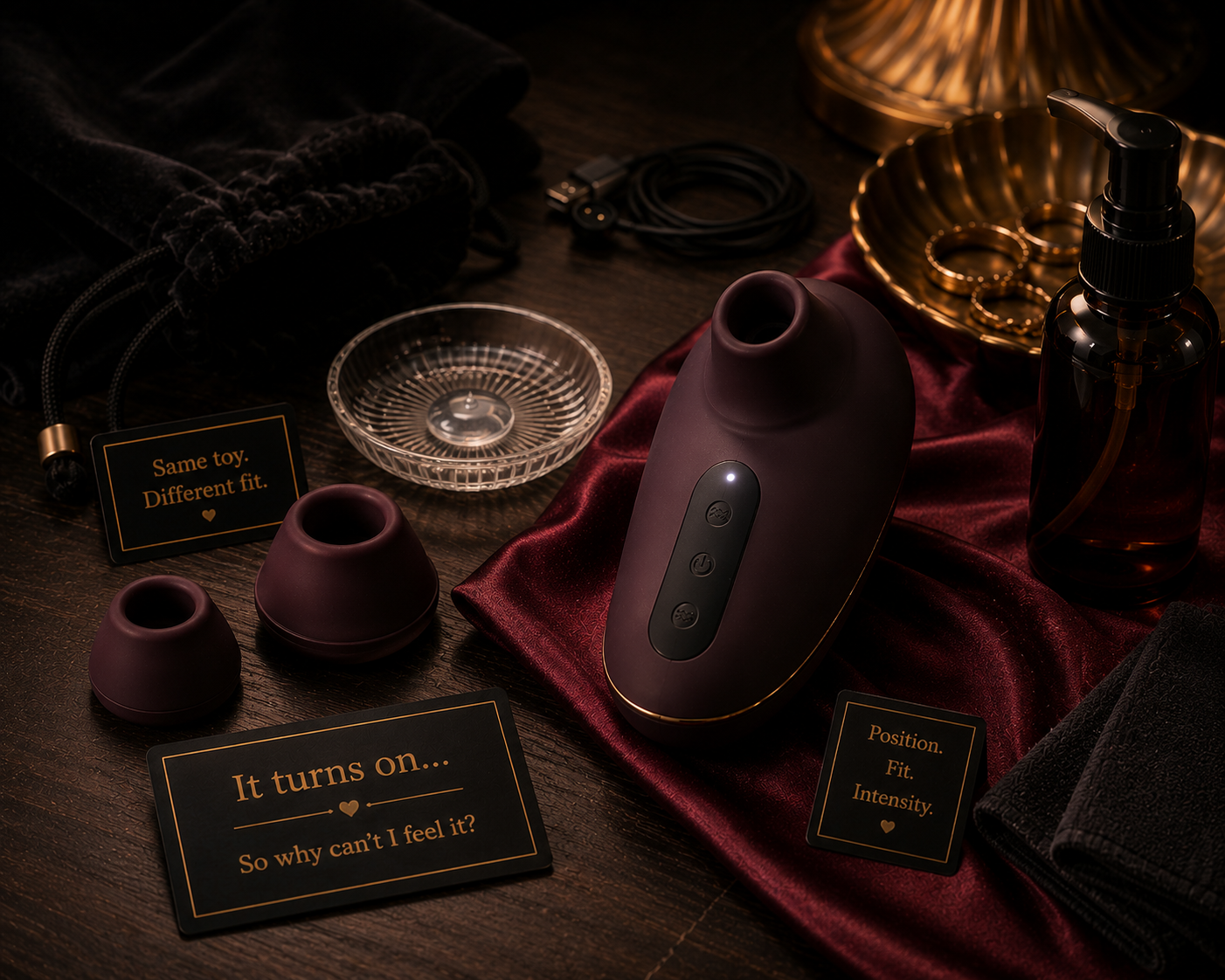
Some products come with more than one stimulation head/nozzle size.
That is not decorative.
Bodies differ.
An opening that is too small may feel overly focused or difficult to position.
An opening that is too large may make it harder to keep the pressure waves centered where you want them.
If your toy includes another head size, try it before deciding the motor is weak.
Why does it stop when I lift it away from my body?
Your toy may have a contact-sensitive quiet mode.
Womanizer calls its version Smart Silence: on compatible models, stimulation activates in direct contact with skin and can return to standby when contact is lost.
So if the motor seems to “turn off” while you are testing it in the air, check the manual.
That may be a feature, not a failure.
A real example of the variables we are talking about
The Womanizer PREMIUM 2 is a useful example because one product brings several of these troubleshooting variables together: pressure-wave stimulation, Smart Silence, multiple intensity levels, and more than one stimulator-head size.
See the current Womanizer PREMIUM 2 listing on Amazon.
The point is not “if yours feels weak, replace it with this.”
The point is that air-pulse performance can depend on technology, contact mode, intensity and head fit—all before you conclude the device is broken.
Should I use lubricant with an air-pulse toy?
A small amount of compatible water-based lubricant around the stimulation area can improve comfort and make positioning easier.
More is not always better.
Flooding the opening with lubricant can make the toy slippery and harder to hold in position.
Use a little, then adjust.
Also follow the toy manufacturer’s lubricant-compatibility instructions.
Why can I hear it but barely feel it?
Possible explanations include:
The opening is not centered.
The head is not making the type of contact the design expects.
You are testing a Smart Silence/contact-sensitive model incorrectly.
The intensity is on a low setting.
The stimulation head is blocked or installed incorrectly.
Your anatomy does not fit that nozzle shape particularly well.
You simply perceive air-pulse stimulation less strongly than vibration.
That last one matters.
A toy can function correctly and still not be your favorite technology.
Start low—but actually explore the range
Some air-pulse devices have a large number of intensity levels.
If level 1 feels like almost nothing, that may be intentional.
Move upward gradually.
Do not jump immediately to the maximum just to prove the toy works.
The goal is to find a useful range, not to turn troubleshooting into an endurance test.
Check whether the nozzle/head is installed correctly
If the stimulation head is removable:
Take it off according to the manual.
Inspect it for damage or debris.
Reinstall it fully.
Make sure it is not folded, warped, or partially detached.
A poorly seated head can change the pressure effect dramatically.
Could water or cleaner be blocking it?
After cleaning, let the stimulation head and any channels/openings dry completely according to the manual.
Residual water or cleaner in the opening can change the sensation or sound.
Do not poke sharp objects into the air channel.
If you think something is blocked internally, use the manufacturer’s support instructions rather than improvising.
What if it works on my hand but not where I want to use it?
That does not automatically mean anything is wrong with your body.
Your hand and genital anatomy are shaped differently and perceive stimulation differently.
Treat the hand test as proof that the mechanism is producing pressure—not proof that you have found the right placement.
Move the head slowly around the external area and experiment with angle and distance.
Do I need a perfect airtight seal?
Not necessarily.
Different air-pulse systems are designed differently.
The useful goal is the position recommended by the manufacturer and a stable, comfortable contact around the stimulation head.
Do not chase a dramatic vacuum seal if the device was never designed to create one.
What if nothing changes at any intensity?
Run a basic device check.
Is it fully charged?
Is travel lock off?
Is the stimulation head installed correctly?
Does the sound or pulse rate change when you change intensity?
Does a contact sensor activate properly?
Is the opening clear and dry?
Does the manufacturer’s troubleshooting guide mention a reset?
If the device behaves identically at every setting, fails to respond to controls, or makes an abnormal sound, that starts looking more like a product problem than a positioning problem.
What if it used to feel stronger?
Compare the current behavior with when it was new.
A noticeable drop in output can point to:
Low battery.
Incomplete charging.
A dirty/damaged stimulation head.
Moisture where it should not be.
Motor/pressure-system wear.
A failing device.
That is different from a brand-new toy that simply feels unfamiliar.
Give unfamiliar technology a fair trial—but not a loyalty oath
A different sensation can take a few sessions to understand.
That does not mean you are obligated to train yourself to like it.
If positioning is correct, the device is functioning, and the sensation still does nothing for you, that is useful information.
Different bodies prefer different stimulation.
The RID air-pulse troubleshooting test
1. Confirm what technology you bought Pressure waves/air pulse? Vibration? Both?
2. Read the contact-feature instructions Especially Smart Silence or similar modes.
3. Check the stimulation head Correct size, clean, dry, installed properly.
4. Start with light, centered contact Do not mash it into place.
5. Add a small amount of compatible water-based lubricant Enough for comfort, not enough to make the whole device slide.
6. Explore several intensity levels Gradually.
7. Change angle and position Millimeters can matter.
8. Separate “not working” from “not for me” Those are different conclusions.
Reader questions, answered
Why does my suction toy not actually suck?
Many so-called suction toys create pressure waves rather than a continuous vacuum. A suction-like sensation does not require the toy to latch onto the body.
Why does it stop when I move it away?
Some models use skin-contact features such as Smart Silence that place the motor in standby when contact is lost.
Does the opening need to cover the clitoris?
Follow the exact manufacturer instructions for your model. Air-pulse products typically position the stimulation opening around the external sensitive area so pressure changes are focused there.
Should I use lube?
A small amount of compatible water-based lubricant can make positioning more comfortable. Check the product instructions first.
What if I hate the sensation?
Then you learned something useful. Air-pulse stimulation is a different sensory experience from ordinary vibration and will not be everyone’s preference.
The RID bottom line
Before declaring an air-pulse toy broken, figure out what it is actually supposed to do.
Center it.
Use light contact.
Check the head.
Check Smart Silence.
Try a little compatible lube.
Explore the intensity range.
And if it works exactly as designed but still leaves you wondering what the fuss is about?
That is allowed too.