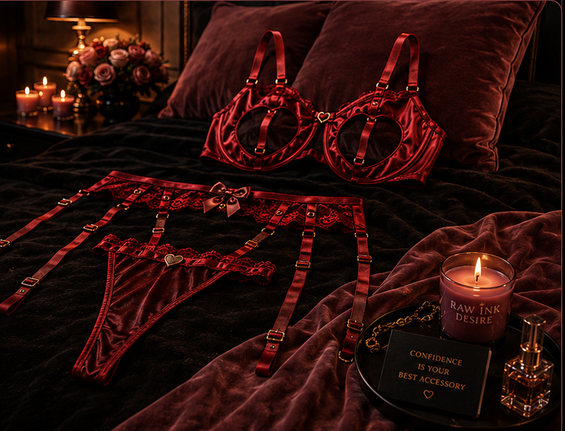
The short answer: your bust, waist, and hips are separate measurements
A matching lingerie set can be one color, one lace pattern, and one design without your body being one size from shoulders to hips.
The problem usually appears when a seller packages the whole set as:
Small.
Medium.
Large.
XL.
That single label may be expected to fit:
Bust.
Underbust.
Waist.
Hips.
Bottom coverage.
Sometimes garter belt too.
If your proportions do not match the brand’s assumed proportions, one piece can fit beautifully while another feels completely wrong.
This is not unusual
Shoppers ask this constantly:
“My top is a small and my bottom is a medium.”
“My bra needs a larger size but my hips are smaller.”
“My bottoms fit but I spill out of the cups.”
“I have to buy two sets to get one complete set that fits.”
That is not evidence that your body is “between sizes.”
It often means the set is using a sizing system that bundles measurements your body does not bundle.
Bra size does not translate neatly into panty size
A bra-sized top is built around at least two measurements:
Band.
Cup volume.
A bottom is usually sized from:
Waist.
Hips.
Those systems are not mathematical partners.
A 34G bra does not imply a particular panty size.
A size-medium bottom does not tell you what bra cup someone wears.
When a brand allows you to choose the bra and bottom separately, it is acknowledging that reality.
Why do inexpensive multi-piece sets use one size?
Bundling makes the product simpler to manufacture, stock, photograph, pack, and sell.
Instead of managing a large matrix of top/bottom combinations, a seller can offer one package in S through XL.
That convenience belongs to the product system.
It does not guarantee that the proportions work for every shopper.
The more fitted the individual pieces are, the more that compromise matters.
Which part of the set should determine my size?
Start with the least adjustable part.
That may be:
A fixed underwire cup.
A non-stretch waistband.
A rigid corset-style panel.
A bodysuit torso.
A narrow leg opening.
Other parts may have more room for adjustment:
Shoulder straps.
Garter straps.
Tie sides.
Hook-and-eye rows.
Stretch lace.
Elastic waistbands.
If the bra cup is fixed but the garter belt has several hooks and stretch, prioritize the cup.
If the top is a stretchy bralette but the bottom has a firm narrow waistband, the bottom may be the harder fit.
Adjustable straps do not fix cup volume
This is one of the easiest mistakes to make with a three-piece set.
If the cups are too small, loosening the straps does not add cup space.
If the cups are too big, tightening the straps does not remove excess volume.
Straps can adjust position and tension.
They cannot redesign the cup.
Stretch does not mean infinite flexibility
A set that says “high stretch” may be more forgiving, but different areas can still behave differently.
The lace body can stretch while:
Cup seams do not.
Elastic edges dig.
Garter belt hardware has limited range.
Decorative straps max out.
The bottom cut rides up.
Look at where the stretch actually exists.
What if the top fits but the bottom is too small?
Do not automatically size up the whole set.
Ask what happens to the top in the next size.
If the larger top becomes loose, unsupported, or gaping, you have confirmed that the set’s fixed ratio is the problem.
Better options:
Buy separates from the same collection.
Choose a seller that allows split sizing.
Look for tie-side or highly adjustable bottoms.
Choose a set where the lower piece has more stretch.
Buy a color/pattern family rather than a pre-bundled set.
What if the bottom fits but the top is too small?
This is especially common when a set uses generic S/M/L cups.
If you normally need a specific bra size, a letter-sized triangle or underwire top may not provide the cup volume you expect.
Look for:
Bra-sized sets.
Adjustable back bands.
Stretch cups.
Soft bralettes without fixed cup shapes.
Sets sold as separate coordinated pieces.
Our Why Does My Bra Gap Even Though It Feels Too Small? guide explains why a fixed cup can fail even when the clothing size looks close.
“Fits cups A–D” is not a complete fit system
A single top cannot magically become four completely different cup constructions.
Sometimes that language means:
The fabric stretches.
The design is soft/unstructured.
The neckline is flexible.
The brand is giving a broad estimate.
That may work for some shoppers.
It is not the same thing as actual band-and-cup sizing.
If bust support matters, read the construction rather than relying on a wide cup-range claim.
Matching does not have to mean packaged together
One of the easiest solutions is to shop within a collection.
Brands often release:
Bra.
Bralette.
Thong.
Brief.
High-waist brief.
Garter belt.
Bodysuit.
in the same lace or color.
That gives you a matched look while allowing each piece to have its own size.
The set is still a set because you chose the pieces together.
If the seller lets you choose split sizes, use it
Some lingerie sellers explicitly allow one size for the top and another for the bottom.
That is the cleanest solution when the design is sold as a set but your measurements cross categories.
Do not “round” both halves into one average size if the seller already gives you separate controls.
Use them.
What about buying two sets and returning the pieces that do not fit?
Check the retailer policy before doing this.
Do not assume a store will accept:
A partial set.
Mixed sizes.
Opened intimate bottoms.
Items with removed tags.
Multiple returns from a bundled SKU.
If a set is sold as one product, the retailer may require the complete original set back.
Our How to Buy Lingerie Online Without Guessing guide explains why return rules should be part of the purchase decision before you order.
Gift buyers: do not guess the set size from clothing
If you are buying lingerie for someone else, “she usually wears medium” is weak information for a structured set.
The useful information is:
Actual bra size.
Preferred bottom size.
Styles she already wears.
Whether she prefers thongs, briefs, high waist, etc.
Whether the brand uses U.S./U.K./EU bra sizing.
A surprise is less romantic if the recipient has to pretend every piece fits.
The RID fixed-set risk test
Before buying a one-size-for-all-pieces set, score each part.
Top Bra-sized? Stretch? Adjustable band? Adjustable straps? Fixed cups?
Bottom Stretch? Waist measurement? Hip measurement? Tie sides? Firm leg openings?
Garter belt Separate waistband? Multiple hooks? Adjustable straps? Decorative only?
Now ask:
Which piece has the least ability to forgive a size mismatch?
That piece should control your decision.
When a fixed-size set can work well
A bundled S/M/L set can be a good buy when:
All pieces are soft and stretchy.
The top has no rigid cup.
The bottom has flexible elastic.
The garter belt adjusts.
Your measurements sit comfortably inside the same size range.
Returns are easy if needed.
Fixed sizing is not automatically bad.
It is simply less customizable.
When to skip the set
Skip when:
Your bust and hips fall into different chart sizes.
The cups are rigid and too vague.
The bottom has little stretch.
The seller gives no component measurements.
Reviews repeatedly mention one half running small.
The set is final sale and the fit risk is high.
You already know bundled sets never fit both halves of you.
There will be another matching set.
Reader questions, answered
Is it normal to wear different sizes on top and bottom?
Yes. Bust, waist, and hip proportions vary independently. Many lingerie collections sell coordinated pieces separately for exactly that reason.
Should I choose the set size based on my bra or hips?
Choose based on the least adjustable piece and the part where a bad fit matters most. If the bra has fixed cups and the bottom stretches, prioritize the bra. If the top is flexible and the bottom is rigid, prioritize the bottom.
Can straps make a small top fit?
They can change positioning, but they cannot add cup volume or band length beyond the garment’s construction.
What if the set only comes in S/M/L?
Compare every measurement the seller provides. If your top and bottom land in different sizes, treat that as real fit risk instead of averaging them.
Is buying separates more expensive?
Sometimes. But buying one set that does not fit—or two full sets just to create one usable combination—can be more expensive too.
Can I mix styles and still call it a matching set?
Absolutely. If the pieces share the same color, lace, embroidery, or collection, they can look intentionally matched without being sold in one package.
The RID bottom line
Your body is not required to be a matching set of measurements just because the lingerie is sold as one matching set.
A bra size is not a panty size.
A waist is not a cup.
A hip measurement is not a band measurement.
When one half fits and the other does not, stop trying to force both halves into the same letter.
The sizing system may be the mismatch.